



London is known for its incredibly diverse hospitality and food and drinks scene.
Our editor in chief, Manuela Willbold, loves to eat out in London and happened to come across Mezcal at La Chingada in Euston. She had never tried it before and the very knowledgeable chef at the restaurant explained what it’s all about. She was very intrigued and decided to try their Mezcalita by recommendation of the chef and she didn’t regret it – a wonderful new flavour experience it was indeed!
She doesn’t want to hide this revelation, so we share it here with everyone interested in coming to London’s best places to find Mezcal.
It appears that Mezcal has taken the global spirits world by storm, evolving from a hidden Mexican tradition into one of the most sought-after drinks in bars from Oaxaca to London.
To understand this deeply complex, smoky spirit, here is our essential guide.
What is Mezcal?
Mezcal is a traditional Mexican distilled spirit made from fermented agave plants. The word comes from the Nahuatl language words metl (agave) and ixcalli (cooked), which literally translates to “oven-cooked agave.”
While it can legally be produced across several certified states in Mexico, the vast majority—around 85% to 90%—is crafted in the southern state of Oaxaca.
What sets artisan mezcal apart is its production process: the agave hearts are roasted in subterranean stone pits, giving the spirit its famous, distinctively smoky flavour profile.
What is Mezcal Made From?

Mezcal is made from the harvested core of the agave plant, known as the piña (because it resembles a giant pineapple).
Unlike other spirits restricted to a single plant variety, mezcal can be made from over 30 different types of agaves.
- Espadín: The absolute backbone of the mezcal world. This cultivated agave accounts for roughly 85% of all mezcal produced because it matures relatively quickly (around 7 to 12 years).
- Wild Varieties: Premium, small-batch mezcals are often made from wild, slow-growing agaves like Tobalá, Arroqueño, or Tepeztate. These plants can take anywhere from 15 to 35 years to mature in the wild, resulting in highly complex, floral, and earthy flavour profiles.
Mezcal vs. Tequila: What’s the Difference?
A common phrase you’ll hear among bartenders is: “All tequilas are mezcals, but not all mezcals are tequila.”
Think of mezcal as the overarching category for agave spirits, while Tequila is a highly specific, strictly regulated subtype.
| Feature | Mezcal | Tequila |
| Agave Type | Over 30 varieties (mostly Espadín) | Strictly 100% Blue Weber Agave |
| Region | Primarily Oaxaca (plus 8 other authorized states) | Chiefly Jalisco (plus limited specific regions) |
| Cooking Method | Pit-roasted underground with wood and charcoal (creates smoke) | Steamed in industrial above-ground brick or stainless-steel ovens |
| Flavour Profile | Intensely smoky, earthy, savoury, and floral | Bright, herbaceous, sweet, and crisp |
How to Drink Mezcal
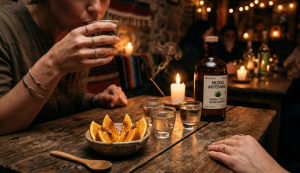
If you want to experience mezcal the traditional way, step away from the shot glasses. Mezcal is a spirit meant to be respected and sipped slowly.
- The Vessel: It is traditionally served in a wide, shallow clay bowl called a copita or a small glass cup called a vaso veladora (which originally held prayer candles). The wide rim allows the intense alcohol vapours to dissipate so you can actually smell the agave.
- The Ritual: “Kiss” the mezcal. Take tiny, microscopic sips to let your palate adjust to the high ABV (usually between 45% and 55%).
- The Accompaniment: It is traditionally served at room temperature alongside fresh orange slices and sal de gusano (agave worm salt mixed with chili). Take a tiny sip of mezcal, then bite into the spiced orange to cleanse your palate and bring out the spirit’s natural sweetness.
Does Mezcal Have Healthy Properties?
Let’s be direct here: mezcal is alcohol, so any potential health benefits are strictly bound to moderate consumption. However, compared to commercial spirits, traditional mezcal does have a few unique properties:
- Pure Ingredients: Authentic artisan mezcal is typically made with just two ingredients: agave and water. It contains no added sugars, syrups, or artificial flavourings, making it naturally gluten-free.
- Fewer Hangovers? Because traditional mezcal relies on natural, wild yeasts for fermentation and contains no chemical additives, many drinkers find they experience fewer hangover symptoms compared to drinking highly processed sugars or lower-quality spirits (“mixtos”).
- Complex Sugars: Agave contains agavins (a type of natural, non-digestible sugar), which don’t spike blood sugar levels the way standard cane sugar does. However, because these sugars are converted into alcohol during distillation, a bottle of mezcal won’t function as a health supplement!
Where to Find Mezcal in London
London has established one of the most vibrant agave-spirit scenes in Europe. If you are looking to buy a bottle or sit down for a tasting flight, here are the top spots to check out:
Best Bars & Mezcalerias
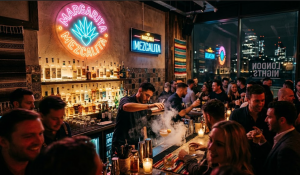
- Doña in Stoke Newington (bardonalondon.com): A vibrant, female-led basement mezcal bar clad in pink feathers and velvet, serving incredible independent, artisanal mezcal brands.
- La Chingada in Euston, Bermondsey & Surrey Keys (lachingada.co.uk): London’s authentic Mexican food and drinks address. They feature an exquisite list of cocktails with mezcal, and tequila curated by their experts.
- Kol Mezcaleria in Marylebone (kolrestaurant.com): Located beneath the Michelin-starred restaurant KOL, this upscale bar blends Mexican spirits with British ingredients for world-class cocktails.
Best Bottle Shops
- Gerry’s Wines & Spirits in Soho (gerrys.uk.com): A legendary London institution packed floor-to-ceiling with one of the most comprehensive physical selections of rare mezcals in the UK.
- The Whisky Exchange in multiple Locations (thewhiskyexchange.com): Excellent brick-and-mortar stores (like Covent Garden and Great Portland Street) with knowledgeable staff who can guide you through different agave varieties.
To understand the official legal classifications of mezcal, you must look at how Mexico’s Norma Oficial Mexicana (specifically NOM-070) regulates the spirit.
Unlike most spirits categories that only categorize by how long a liquid sits in a barrel, mezcal is legally classified in two distinct ways: by how it is made (Categories) and by how it is aged (Classes).
Mezcal Product Classifications – A Buyer’s Guide to How it’s made
This is the most important classification for mezcal purists. Modified heavily in 2016, the law divides mezcal into three categories based strictly on the technology allowed during cooking, crushing, fermentation, and distillation.
[Traditional / Historical] ──> Ancestral ──> Artisanal ──> Mezcal ──> [Industrial / Modern]
Mezcal Ancestral (Ancestral Mezcal)
This is the most traditional, labour-intensive, and strictly regulated category. It completely bans modern machinery.
- Cooking: Must be done in underground earthen pits.
- Crushing: Restricted to sensory/manual methods—using wooden mallets (canoas) by hand, or a stone wheel (tahona).
- Fermentation: Done in stone pits, soil pits, tree trunks, brick tanks, or animal hides. Crucially, the agave fibers (bagazo) must be included in the fermentation.
- Distillation: Must take place in direct-fire clay pots (ollas de barro) with clay or wooden still heads. The fibres must remain in the still during distillation.
Mezcal Artesanal (Artisanal Mezcal)
The vast majority of premium mezcal on the market falls into this category. It allows for slightly more efficiency while maintaining traditional craftsmanship.
- Cooking: Underground earthen pits or above-ground brick ovens (hornos de mampostería).
- Crushing: Wooden mallets, stone tahona wheels, or mechanical shredders (trapiches).
- Fermentation: Like ancestral (wood, stone, brick, etc.), and fibres are typically included.
- Distillation: Direct-fire copper alembic stills (the most common method) or clay pots.
Mezcal
If a bottle is just labelled “Mezcal” without “Ancestral” or “Artesanal,” it means it was made using modern industrial methods.
- Cooking: Can use massive autoclaves (industrial pressure cookers).
- Crushing: Industrial diffusers or multi-stage mills.
- Fermentation: Large stainless-steel vats.
- Distillation: Continuous column stills or stainless-steel alembics. This method yields a much higher volume but strips away most of the complex artisanal flavours and smoky characteristics.
2. Mezcal Aging Classes – A Buyer’s Guide to how long it rests
Once the mezcal is distilled, it is classified by its maturity and whether any post-distillation flavours were added.
- Joven (or Blanco): Clear, unaged spirit bottled directly after distillation (or rested in inert containers like glass for less than 2 months). This is how the vast majority of traditional mezcals are consumed, as aging in wood tends to mask the distinct flavours of the agave plant itself.
- Madurado en Vidrio (Matured in Glass): Rested in large glass carboys for more than 12 months, usually buried underground or kept in a dark, temperature-controlled environment. This softens the alcohol bite while preserving 100% of the raw agave flavours without adding wood notes.
- Reposado: Aged in wooden casks (usually oak barrels) for 2 months to 1 year. The spirit begins to take on a light golden hue and subtle notes of vanilla and caramel.
- Añejo: Aged in wooden casks with a capacity under 1,000 litres for at least 1 year. It turns a deeper amber colour and develops heavy wood, chocolate, and spice characteristics.
Special Additive Designations
You will also occasionally see two other official legal classes on labels:
- Abocado con… (Flavoured with): Mezcal that has had ingredients added directly to the bottle to alter the flavour or colour—most famously Abocado con Gusano (with an agave worm), or flavoured with damiana, lemon, or honey.
- Destilado con… (Distilled with): This refers to the traditional Pechuga style. During the second or third distillation, ingredients like seasonal fruits, grains, spices, and a raw turkey or chicken breast (pechuga) are hung inside the still. The vapours pass through these ingredients, creating a highly complex, savoury, and ceremonial mezcal.
Now you should be ready to confidently give Mezcal a try if you’re into exploring new flavours.
We welcome shared experiences, reviews and recommendations here so speak to us about it!

Marketer, blogger, content creator and digital nomad based in London always curious about London business news, stories, events and developments.
